1

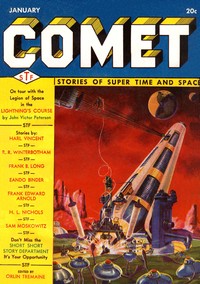
Lunar Station — Story, Setting & Ideas
(0 User reviews)
623
Project Gutenberg
2021
Not confirmed
Science fiction; Short stories; Adventure stories; Moon -- Fiction; Human-alien encounters -- Fiction
Readers of public-domain and historical texts
Project Gutenberg digital edition
en
Edition facts
Words
9,026
Reading time
40 min
Text sections
1
Lunar Station — Story, Setting & Ideas can be approached with a clearer sense of reading commitment from its source measurements: 9,026 words, 40 min estimated reading time, and 1 detected text section.
The text analysis averages about 12.2 words per sentence, while the detected sections provide another way to judge how the source is divided.
Project Gutenberg metadata also associates the work with “Science fiction,” connecting these edition facts with the source record’s subject description.
Source:
Project Gutenberg record #64817
Harl Vincent's 1941 novella uses a lunar mining station as the setting for a fast-paced power struggle. The narrative shifts between technical jargon, colloquial banter, and tense confrontations, with abrupt scene changes and a focus on physical movement and dialogue to drive the plot.
Read the complete public-domain text at its original source.
Read on Project GutenbergHarl Vincent's Lunar Station opens with a jolt—literally. The first paragraph drops the reader into a moonbase where chief engineer Bill Bonwitt feels something is wrong, conveyed through the percussive rhythm of his hob-nailed boots on metal steps. The dialogue between Bonwitt and radio operator Val Crane establishes a casual, bantering tone that quickly gives way to alarm as the moon shifts on its axis. Vincent relies on sensory details—a quivering floor, a swinging Earth, a snap that jars insides—to ground the reader in the physical experience of the crisis. The narrative voice is brisk, favoring short, punchy sentences and exclamations like "Cripes!" and "Nuts." This opening establishes a pattern of rapid scene changes and a focus on immediate action rather than exposition.
Dialogue as a Driver of Pace
Vincent uses dialogue not just to convey information but to control the story's tempo. Early exchanges between Bonwitt and Crane are clipped and overlapping, with interruptions like "Wha-a-at!" and "Right" that mimic real conversation and accelerate the narrative. Later, when Bonwitt confronts the villainous Peterson, the dialogue becomes more deliberate, with longer speeches that slow the pace and build tension. Peterson's monologue about his plan—"I'll kill off the Selenites... with a supersonic generator"—is delivered in a measured, almost casual tone that contrasts with the violence of his intentions. This shift in pacing signals a move from action to psychological threat. The dialogue also reveals character: Bonwitt's lies ("Sure, I'll join up") are terse, while Peterson's self-justifications are expansive. Vincent's ear for vernacular—"Damned if I don't think you've got something there"—keeps the language grounded even as the plot veers into melodrama.
Physicality and Setting as Narrative Levers
The story's setting is rendered through constant physical cues: the clatter of boots, the vibration of the moon, the "black velvet of the heavens" seen through a crystal dome. Vincent uses these details to anchor the reader in the lunar environment and to signal shifts in mood. When the moon quakes, the text describes it as a "prolonged but diminishing vibration" that affects the characters' bodies—"stunned, breathless." The setting is not static; it reacts to the plot. The mercury mines, the radio room, and the dome are stages for confrontation, and Vincent moves characters between them with speed, often via staircases that echo with footsteps. This emphasis on movement—running, ducking, climbing—creates a sense of urgency. Even the technical elements, like the ethertype machine and the Atomic I spaceship, are described in terms of their sensory impact: "tape chattered," "jets spouting trails of blazing magnificence." The setting is never merely decorative; it is a participant in the action.
Voice and the Shift from Banter to Brutality
The narrative voice in Lunar Station undergoes a distinct shift as the story progresses. Early chapters are marked by colloquial, almost flippant dialogue—Bonwitt and Crane trade insults and jokes even as the moon wobbles. This voice establishes a camaraderie that makes later violence more jarring. When Crane is killed—"his head was missing—blasted away"—the prose becomes stark and immediate. The exclamation "With a screech of pure animal fury" is a departure from the earlier banter, signaling a tonal shift toward raw emotion. Vincent's third-person narration remains close to Bonwitt's perspective, using free indirect discourse to convey his thoughts: "Mad, totally mad, this scheme of Peterson's." The language of the narration itself changes: early descriptions are vivid but matter-of-fact; later passages include more interiority and moral judgment. This evolution in voice mirrors the protagonist's journey from a competent engineer to a man confronting madness and murder.
Readers should pay attention to how Vincent uses the lunar setting not as a backdrop but as a source of tension—the moon's instability mirrors the plot's unpredictability. The story's brevity (under 10,000 words) means every scene serves multiple purposes: advancing the plot, revealing character, or shifting tone. The abrupt transitions between action and dialogue reward close attention to pacing. For those interested in mid-century pulp science fiction, Lunar Station offers a compact example of how voice and setting can drive a narrative forward without sacrificing character development.
I keep thinking about how Lunar Station never lingers on the quiet between its clashes, the way the lunar dust settles only off-page. That hurried, breathless quality made me recall a different sort of stillness, something gentler in The Third Little Green Man — Story, Setting & Ideas. There, the small moments felt like they had room to breathe, almost like a long exhale after all that tension.
There are no reviews for this eBook.
There are no comments for this eBook.
Reader reflection
How will you remember this book?
Save your reaction, strongest insight, and memorable passage.
Your progress
0
/
10
2
Did this book hold your interest?
3
Would you pass this book on to a friend?
4
How easy was the book to follow?
5
How would you rate its originality?
6
Did you relate to its people, ideas, or situations?
7
Did the story or argument move comfortably?
8
Could you apply anything you learned?
9
What changed or sharpened your thinking?
10