1

An Incident on Route 12 — Inside the Classic
(0 User reviews)
371
Project Gutenberg
2007
Not confirmed
Science fiction; Short stories; Criminals -- Fiction; Human-alien encounters -- Fiction
Readers of public-domain and historical texts
Project Gutenberg digital edition
en
Edition facts
Words
5,015
Reading time
22 min
Text sections
1
Before opening An Incident on Route 12 — Inside the Classic, the edition data offers a quick orientation: 5,015 words, 22 min estimated reading time, and 1 detected text section.
The text analysis averages about 19.7 words per sentence, while the detected sections provide another way to judge how the source is divided.
Project Gutenberg metadata also associates the work with “Science fiction,” connecting these edition facts with the source record’s subject description.
Source:
Project Gutenberg record #21897
An editorial note examining James H. Schmitz's use of terse, sensory prose and strategic pacing in a 1950s crime-sci-fi hybrid, focusing on the opening's mechanical failure, the protagonist's calculated baiting, and the intrusion of alien elements.
Read the complete public-domain text at its original source.
Read on Project GutenbergJames H. Schmitz opens 'An Incident on Route 12' with a precise mechanical failure: 'a series of sharp, clanking noises' from under the hood. The protagonist, Phil Garfield, reacts not with panic but with a 'sick helplessness' that quickly curdles into calculation. The prose mirrors his mindset—short, clipped sentences ('One dead. Perhaps two.') that convey a man accustomed to risk. Schmitz avoids melodrama; instead, he lets the stalled Packard and the dark road establish a stage for a predator-prey dynamic that soon acquires an alien dimension.
Diction of a Criminal Mind
Schmitz's word choices align tightly with Garfield's perspective. The narrative refers to the bank guard's 'clumsy play at being a hero' and the 'fool woman' who 'ran screaming into their line of fire.' These phrases reveal Garfield's self-justifying contempt, not authorial judgment. The vocabulary is concrete: 'suitcase,' 'gun,' 'flashlight,' 'box of shells.' Abstract reflection is absent. When Garfield considers leaving the car as bait, the reasoning is purely tactical: 'To anybody driving past it would merely suggest a necking party, or a drunk sleeping off his load.' The simile is deliberately mundane, grounding the story in a recognizable American roadside before the genre shift.
Pacing Through Physical Action
The opening sequence is a model of compressed action. Schmitz moves Garfield through a series of deliberate steps: checking the watch, switching off headlights, climbing out, retrieving items, positioning the car. Each action is described in one or two sentences, creating a rhythm that mimics urgent competence. The sentence 'The Packard rolled on, getting rid of its momentum, and came to a stop' personifies the car while keeping the focus on Garfield's agency. The pace slows only when Garfield waits among the trees, gun ready—a pause that signals the story's impending intrusion of the unknown. The excerpt ends with him 'standing waiting,' a poised moment before the alien encounter.
Setting as a Character
Route 12 is not merely a location but an active element in the story's tension. Schmitz describes it with minimal but effective details: 'no other headlights in sight,' 'no light from a building showing on the forested hills.' The darkness is total, isolating Garfield from civilization. The 'shoulder of the road' and 'trees and undergrowth of the slope' become a makeshift hideout. The setting is generic enough to be any rural American highway, yet specific in its emptiness—a liminal space where a bank robber can become prey. The lack of landmarks reinforces Garfield's vulnerability; he is a man out of his element, reduced to using his broken car as a trap.
The Alien Intrusion
While the excerpt does not reveal the nature of the alien encounter, the catalog subject 'Human-alien encounters' signals a genre shift. Schmitz's technique is to embed the fantastic within the mundane. The careful realism of the car breakdown and Garfield's methodical preparations make the eventual intrusion more jarring. The story's title—'An Incident on Route 12'—suggests a report, a single event that disrupts an otherwise ordinary night. The authorial choice to begin with a crime story frame implies that the alien element will not be a separate plot but a complication of Garfield's existing predicament. The reader is left to wonder how the 'booty' of the subtitle applies to both the stolen money and Garfield himself.
Schmitz's story rewards attention to its structural economy: every detail of the opening serves both the crime plot and the coming science-fiction twist. Readers may note how the author withholds information about the aliens, letting the human character's limited perspective drive the narrative. The prose remains lean, favoring implication over explanation—a style that suits the story's blend of hardboiled crime and speculative fiction.
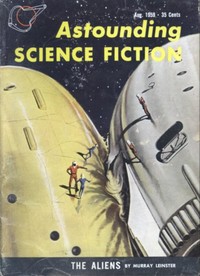
Years at the circulation desk teach you how certain books keep each other’s company on the shelf. Schmitz’s lean, mechanical dread—that failing engine, the deliberate provoking—finds a quiet echo in The Aliens — Text and Context, where strangeness arrives not with fanfare, but as a settled fact. Both trust the reader to feel the chill before naming it.
There are no reviews for this eBook.
There are no comments for this eBook.
Reader reflection
What did you think of this book?
Answer a few questions and save a private reflection on this device.
Your progress
0
/
10
2
What was your overall reaction to the book?
3
How likely are you to recommend this book?
4
What was the reading difficulty like?
5
Did anything about the book feel genuinely new?
6
Which element worked best for you?
7
Did the book give you something worth debating?
8
Did the story or argument move comfortably?
9
In one sentence, what did you learn?
10