1

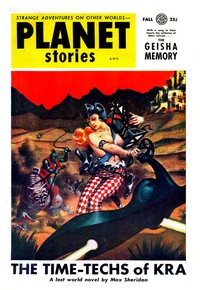
The Time-Techs of Kra — Story, Setting & Ideas
(0 User reviews)
65
Project Gutenberg
2020
Not confirmed
Science fiction; Time travel -- Fiction; Adventure stories; Human-alien encounters -- Fiction; Insects -- Fiction
Readers of public-domain and historical texts
Project Gutenberg digital edition
en
Edition facts
Words
21,903
Reading time
96 min
Text sections
3
Before opening The Time-Techs of Kra — Story, Setting & Ideas, the edition data offers a quick orientation: 21,903 words, 1 hr 36 min estimated reading time, and 3 detected text sections.
The text analysis averages about 15.4 words per sentence, while the detected sections provide another way to judge how the source is divided.
Project Gutenberg metadata also associates the work with “Science fiction,” connecting these edition facts with the source record’s subject description.
Source:
Project Gutenberg record #63716
Max Sheridan's 1954 time-travel adventure opens with a timid man who is not what he seems, then shifts to stranded humans debating teleology and multi-dimensional escape from giant insect Kralons. The excerpts reveal a story built on disguise, theoretical physics, and a looming alien threat.
Read the complete public-domain text at its original source.
Read on Project GutenbergThe first excerpt introduces Willard Randall, a man who initially appears as a timid, gray figure peering into a transportation shaft, only to reveal a confident alter ego once alone with the Terminal Agent. This transformation—from colorless voice and drooping shoulders to square posture and dark eyes—establishes a pattern of hidden depths. The Diamvator, a tube that drops passengers to the Antipodes, is the story's first speculative device, presented with bureaucratic detail (schedules, brochures) that grounds the fantastic in mundane routine.
A Shape-Shifting Opening
The opening scene hinges on misdirection. Randall's initial timidity is so exaggerated that the guard's condescension feels earned, yet the moment the office door closes, his demeanor shifts completely. The prose emphasizes physical cues: the pale gray eyes that darken, the thin voice that gains depth. This is not merely a disguise but a deliberate narrative strategy—the reader is invited to watch a performance. The Diamvator itself, a hole in the ground guarded by steel lattice, is described with the same matter-of-factness as a subway, yet its function (travel through the Earth's interior) is never explained in the excerpt. The story trusts the reader to accept the device and focus on Randall's double identity.
The Physics of Escape
Later excerpts shift to a group of humans stranded in a prehistoric world, dominated by the Kralons—giant intelligent insects. The physicist Gordo Lanson introduces the theory of Teleology, arguing that knowledge of a future event can influence past actions through a Teleomagnetic effect. This is not just technobabble; it is a plot mechanism. Lanson's analogy of the Flatlander trapped in a circle illustrates the limits of three-dimensional thinking when facing a multi-dimensional problem. The dialogue is deliberately pedagogical, with Malherne acting as the skeptical student. The stack of crude parchmentlike sheets covered in figures suggests that the solution is mathematical, not magical, grounding the fantastical premise in a logic of energy and flux.
Alien Masters of Time
The Kralons are introduced not as monsters but as learned giant insects who seined the stream of Time for universal truth. The catalog description frames them as masters, but the excerpts show them as a threat that has pulled humans from various ages. The story's title refers to the Time-techs of Kra, yet the excerpts never define Kra or explain the Kralons' technology. This deliberate withholding creates a sense of mystery. The humans' predicament is not just survival but intellectual escape: they must understand the Kralons' time-seining to reverse it. The dialogue between Lanson and Malherne suggests that the solution requires a paradigm shift, not brute force.
Voice and Structure
Sheridan's prose is efficient, favoring dialogue and action over description. The opening relies on visual cues (gold-rimmed spectacles, blue uniform, granite floor) to establish setting, but the middle sections are almost entirely conversational. The structure is episodic: the first excerpt is a standalone vignette of disguise, while the later ones are a lecture on time theory. The transition between these tones is abrupt, suggesting the story may jump between Earth and the prehistoric world without transition. The excerpts contain no resolution—the humans are still planning, the Kralons are still offstage. Readers should expect a plot driven by problem-solving rather than action, with the Kralons as a looming, barely glimpsed presence.
The excerpts offer a puzzle: how does Randall's opening disguise connect to the stranded time-travelers? The story likely weaves multiple timelines together, with the Diamvator as a red herring or a clue. Pay attention to the parchmentlike sheets and the repeated emphasis on multi-dimensional thinking—the solution may involve a twist on the Flatlander analogy. The Kralons remain unseen, their motives unclear; the story's tension lies in whether human ingenuity can outthink an alien intelligence that controls time itself.
There’s a particular loneliness in The Time-Techs of Kra, that moment when the disguise drops and the insect hum begins. I kept thinking about how we carry hidden selves into strange futures. It reminded me of the quieter unease in The Aliens — Text and Context, where the strangeness isn’t just out there, but already in how we see. A familiar ache, really.
There are no reviews for this eBook.
There are no comments for this eBook.
Reader reflection
What was your reading experience?
Capture what you thought, learned, and would like to remember.
Your progress
0
/
10
2
Did this book hold your interest?
3
Would you encourage someone else to read it?
4
How demanding did the text feel?
5
How understandable was the text?
6
Would a second reading be valuable?
7
Which element worked best for you?
8
Did this book create an emotional response?
9
What did this book teach you most?
10