1

Joe Carson's Weapon — Inside the Classic
(0 User reviews)
1069
Project Gutenberg
2020
Not confirmed
Science fiction; Short stories; Humorous stories; Martians -- Fiction; Human-alien encounters -- Fiction
Readers of public-domain and historical texts
Project Gutenberg digital edition
en
Edition facts
Words
9,508
Reading time
42 min
Text sections
1
Joe Carson's Weapon — Inside the Classic can be approached with a clearer sense of reading commitment from its source measurements: 9,508 words, 42 min estimated reading time, and 1 detected text section.
The text analysis averages about 17.1 words per sentence, while the detected sections provide another way to judge how the source is divided.
Project Gutenberg metadata also associates the work with “Science fiction,” connecting these edition facts with the source record’s subject description.
Source:
Project Gutenberg record #63429
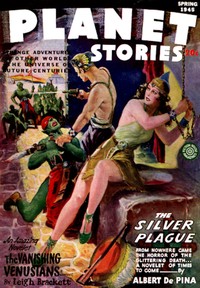
In this 1945 Planet Stories tale, James R. Adams blends science fiction with satire as Martian invaders mistake a fan's humorous letter for a secret weapon. The story's humor arises from the gap between the Martians' literal-mindedness and the Earthling's playful jargon, with a narrative voice that shifts from broad parody to tense standoff.
Read the complete public-domain text at its original source.
Read on Project GutenbergThe story opens with Joe Carson rereading a letter he has written to the editor of Galactic Adventures, a science-fiction magazine. The letter is a parody of fan correspondence, full of exaggerated action: Joe imagines himself stealing a tricycle, battering through a crowd, and clutching the magazine as a treasure. The tone is deliberately over-the-top, mocking the very genre the story belongs to. This self-aware humor sets the stage for a narrative that plays with the conventions of pulp SF.
Adams establishes a contrast between Joe's mundane setting—a desk with an open magazine—and the grandiose language of his letter. The reader is introduced to a protagonist who is both a fan and a satirist, a detail that becomes crucial when the Martians arrive.
The Fan as Satirist
Joe Carson's letter is the story's first extended passage, and it reveals a great deal about the narrative voice. The letter is written in a breathless, first-person style, full of hyperbolic action: “I slyly crawl from my cage,” “I dash to the fence and clear it with a prodigious leap,” “I batter my way through the screaming throng.” The target of the satire is the clichéd fan letter, but also the magazine covers and stories that fans love and hate. Joe complains about a “BEM” (bug-eyed monster) on the cover and demands a different artist. This is not a generic complaint; it is a specific reference to the visual tropes of 1940s SF magazines.
The letter also introduces the concept of a “joke” as a weapon—a phrase that the Martians later take literally. Adams uses the letter to establish Joe's voice as playful and ironic, a tone that persists even when the Martians interrogate him. The humor is not just in the situation but in the language itself: Joe describes a “low-grade joke” that could “lay him out cold as a mackeral.” The misspelling is part of the character's voice, suggesting a casual, unpolished style.
Martian Misinterpretation
When the Martians Harl and Kir-Um confront Joe, the story shifts from broad comedy to a more suspenseful tone. The Martians speak in formal, stilted English: “You cannot deceive us, boy,” and “We want the plans of this amazing contrivance.” Their language is devoid of humor, which makes Joe's slang and jargon seem alien to them. They interpret his letter as a serious threat, and his explanation that it was “just a joke” only deepens their confusion.
Adams uses the Martians' perspective to create dramatic irony. The reader knows that Joe is harmless, but the Martians see him as a “repulsive gargoyle” wielding terrible power. Their fear is described in visceral terms: “sandpaper tongues darted nervously across dry lips.” The narrative voice here is closer to the Martians' point of view, using words like “creature” and “fiendish power” to heighten the tension. This shift in voice—from Joe's irreverent slang to the Martians' formal terror—is one of the story's key structural features.
Pacing and the Standoff
The story's pacing accelerates as the Martians debate their next move. Kir-Um tries to maintain optimism, thinking they can “improve the Jokes” and turn them into weapons. But the narrative voice undercuts this hope with a return to Joe's perspective: the Martians observe Joe's “odd, violent vibrating of the entire body, accompanied by spasmodic grunts and squeaks”—which is simply laughter. Adams uses this moment to remind the reader of the absurdity of the situation.
The excerpt ends with the Martians in a state of near-panic, contemplating failure. The pacing slows as they consider their options, then quickens again with Kir-Um's renewed determination. The story's humor depends on this alternation between the Martians' high-stakes seriousness and Joe's oblivious amusement. The narrative voice remains flexible, shifting between the Martians' formal thoughts and Joe's colloquial asides, creating a rhythm that keeps the reader engaged.
Readers should pay attention to how Adams uses the contrast between the two groups' languages to drive the plot. The Martians' inability to understand metaphor or humor is not just a joke—it is the engine of the story. The narrative voice moves between Joe's fanboy slang and the Martians' formal diction, and this shift is the primary source of both comedy and tension. The story is short, so the pacing is tight; the humor works best when read quickly, allowing the absurdity to build.
I remember smiling at how the Martians in Joe Carson's Weapon took every playful word at face value, mistaking wit for warfare. It made me think of another old favorite, where time itself becomes just as slippery and strange. There's a gentle ache in both, a sense of being misunderstood across vast distances. The Winds of Time — Reading Companion carries that same quiet, wistful humor.
There are no reviews for this eBook.
There are no comments for this eBook.
Reader reflection
Record your reading impressions
A brief reflection can help important ideas stay with you longer.
Your progress
0
/
10
2
Was reading this book enjoyable?
3
How likely are you to recommend this book?
4
How demanding did the text feel?
5
How valuable was this book for your own interests?
6
Was the book what you thought it would be?
7
Did any part of the book stay with you emotionally?
8
How closely did the book connect with your experience?
9
What is the main idea you are taking away?
10