1

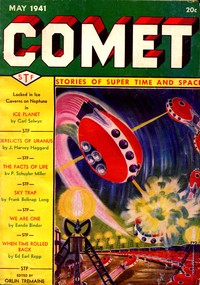
Ice Planet — Themes and Context
(0 User reviews)
703
Project Gutenberg
2021
Not confirmed
Science fiction; Adventure stories; Man-woman relationships -- Fiction; Journalists -- Fiction; Mystery fiction; Weapons -- Fiction; Escaped prisoners -- Fiction; Neptune (Planet) -- Fiction
Readers of public-domain and historical texts
Project Gutenberg digital edition
en
Edition facts
Words
15,583
Reading time
68 min
Text sections
2
The source record for Ice Planet — Themes and Context measures this digital text at 15,583 words, 1 hr 8 min estimated reading time, and 2 detected text sections.
The text analysis averages about 12.1 words per sentence, while the detected sections provide another way to judge how the source is divided.
Project Gutenberg metadata also associates the work with “Science fiction,” connecting these edition facts with the source record’s subject description.
Source:
Project Gutenberg record #64873
Bill Ricker, a journalist on a space liner, observes a handcuffed Venusian woman accused of murder. As he investigates, the story shifts from a crime report to a conspiracy involving a stolen secret, a planetary takeover, and a race against time.
Read the complete public-domain text at its original source.
Read on Project GutenbergThe story opens aboard a space ship approaching Neptune, where journalist Bill Ricker observes a handcuffed Venusian woman accused of murder. The narrative voice is colloquial and immediate, mixing Ricker's internal thoughts with dialogue from a garrulous sourdough passenger. The setting is established through specific visual details: Neptune is described as a 'pale green globe' and a 'ghostly emerald,' while the ship's interior includes a red-leather chair and a narrow aisle. The opening scene introduces a mystery—the woman's crime and her connection to a famous inventor—while hinting at larger forces at play.
Structure and Scene Shifts
The narrative moves quickly between confined spaces: the space liner's cabin, a private room where Ricker confronts the villain Trexel, and later locations implied by the excerpts. Each scene is introduced with minimal transition, relying on dialogue and action to propel the plot. The opening chapter establishes a classic mystery setup—a journalist observing a prisoner—but the story soon shifts to a conspiracy involving a stolen secret and an imminent attack on Earth. The pacing is brisk, with scenes often ending on a cliffhanger or a decisive line of dialogue, such as Trexel's order to shoot Ricker.
Recurring Images and Motifs
Two images recur: the 'pale green globe' of Neptune, described as a 'ghostly emerald' and a 'snowball of frozen gases,' and the handcuffs linking the Venusian woman to her guard. The planet is both a backdrop and a symbol of isolation and danger. The handcuffs visually reinforce the theme of captivity—literal for the prisoner, metaphorical for Ricker as he becomes entangled in the plot. Other repeated details include references to weapons (a pistol, a 'flash of a pistol') and the contrast between the vastness of space and the claustrophobic interiors where confrontations occur.
Voice and Dialogue
The dialogue is brisk and colloquial, with characters using slang like 'shore am, podner' and 'mowed him down.' Ricker's internal thoughts are sardonic, as when he reflects that Neptune is 'worthless as was half the universe—because the woman ... had killed a man.' The villain Trexel speaks in clipped, authoritative sentences, while the Venusian woman, Molly Borden, shifts from silent observation to sudden defiance. The excerpts show a preference for short exchanges that advance the plot, with occasional longer speeches, such as Ricker's argument that 'you can't conquer a planet.'
Setting and Atmosphere
The story is set in a future where space travel is routine, but the technology is described in functional terms: a 'space ship,' a 'power plant,' a 'ring of solid hydrogen and helium.' The atmosphere is one of tension and paranoia, with characters constantly watching each other. The opening scene emphasizes the loneliness of space—'bleak, desolate, a snowball of frozen gases'—while later scenes in Trexel's room feel stifling, with a 'stifled breath' and a 'dead cigar.' The contrast between the vastness of space and the intimacy of the ship's cabin creates a sense of confinement that mirrors the characters' entrapment in the conspiracy.
Readers should pay attention to how the story uses its limited word count to shift from a crime mystery to a planetary thriller. The handcuffs and the green planet are not just set dressing but visual anchors for the themes of captivity and danger. The dialogue-driven scenes reward close reading for clues about character motives, especially the sudden change in Molly Borden's behavior. The excerpts suggest a tightly plotted narrative that relies on swift scene changes and a consistent voice.
There’s something about Bill Ricker’s quiet suspicion aboard that liner—watching a handcuffed stranger, wondering what’s really behind the official story—that reminds me of an older friend’s cautious optimism in Ice Planet. It lingers, that feeling, and I find myself thinking of it whenever I revisit The Third Little Green Man — Story, Setting & Ideas, as if both worlds share a certain lonely curiosity. I miss that kind of unspoken weight.
There are no reviews for this eBook.
There are no comments for this eBook.
Reader reflection
What did you think of this book?
Answer a few questions and save a private reflection on this device.
Your progress
0
/
10
2
How much did you enjoy the reading experience?
3
How likely are you to recommend this book?
4
How much effort did this book require?
5
Did the book offer a fresh perspective?
6
Could you see yourself revisiting this book?
7
What was its emotional impact?
8
Did the book meet your expectations?
9
What did this book teach you most?
10