1

Wanderlust — Themes and Context
1489
1
Project Gutenberg
2021
Science fiction; Short stories; Fathers and sons -- Fiction; Space ships -- Fiction; Farmers -- Fiction
Readers of public-domain and historical texts
Project Gutenberg digital edition
en
Edition facts
Words: 6,171
Reading time: 27 min
Text sections: 1
Source:
Project Gutenberg record #65936
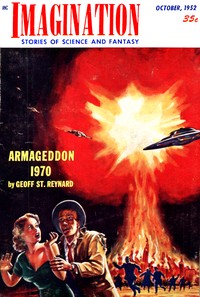
In Alan E. Nourse's 1952 story, a farmer's son is drawn to a rocket landing, rekindling his father's traumatic memories of a space disaster that left him blind. The narrative contrasts rural life with the lure of space, using sensory details and a gold medal for heroism as a silent token.
Editorial Edition Score
4.4/5
★★★★★
★★★★★
Calculated from edition completeness, EPUB availability, text structure and catalogue metadata. Not a user rating.
Edition quality
The story opens with George Barlow sensing unease as his son Tad returns from town, a feeling that crystallizes when Tad announces a rocket has landed early at Dillon's Landing. The contrast between the father's quiet dread and the son's bright excitement is established immediately: Tad's "sunbaked hair" and "sharp eyes sparkling" versus George's chill and the "cloud on his father's face." The setting—a farm awaiting a shipment of "Venusian taaro"—grounds the narrative in a rural, agricultural routine that the rocket's arrival disrupts.
Sensory Contrasts and the Weight of Silence
The text relies on sensory details to mark the divide between father and son. Tad perceives the rocket as a visual spectacle: "It catches the sunset like you never saw before." George, however, experiences the world through sound and touch—"stroking old Snuffy behind the ears," listening to Tad's three-wheeler, and feeling the "cool east breeze." The father's blindness, revealed only at the story's end, reframes these earlier passages: his unease is not just parental worry but a visceral reliving of trauma. The silence after Tad's announcement is heavy; George "sat quietly, waiting" while Tad stands on the ridge, looking down the valley. This spatial separation—father below, son above—mirrors their emotional distance.
The Wanderlust as Inherited Burden
The story's title, Wanderlust, is personified as a "hard taskmaster" that exacts "terrible fees." George reflects that he "had known since Tad was born that it would be useless" to fight the boy's urge to leave. The narrative does not explain the source of this urge; it is presented as an innate, irresistible force. Tad's excitement is described as an "aura" that fills the room, while George's memories are a "horrible moments" of "rumbling, jolting thunder" and "atomic fires gone wild." The father's scarred cheeks and sightless eyes are physical evidence of the price he paid. The gold medal—a disc "for Heroism in Space"—becomes a silent, ambiguous gift: a token of past glory or a warning?
Domestic Routine Versus Cosmic Call
The farm is depicted through concrete tasks: the need for tractor bolts, the cutting of oats, the arrival of Venusian taaro. Florence Barlow, Tad's mother, is anchored to the kitchen, pushing back "an unruly whisp of graying hair" and dismissing the rocket as something to "gawk at." Tad, by contrast, forgets his errand because "the ship was landing just as I got into town." The rocket is described as "tall and slim," a phallic symbol of escape from the cyclical labor of the farm. George's final act—slipping the medal into Tad's half-packed bag—occurs in darkness, as tears stream down his scarred cheeks. The story ends not with Tad's departure but with the father's silent grief, leaving the reader to wonder what the son will make of the medal.
Readers should attend to the story's use of sensory limitation: George's blindness is withheld until the final paragraph, forcing a rereading of earlier scenes. The gold medal is never discussed between father and son; its placement in the bag is a private, wordless gesture. The narrative leaves Tad's fate unresolved, focusing instead on the father's internal struggle. The tension between the domestic and the cosmic is embodied in the farm itself, a place where Venusian crops and earthly oats coexist, but where the lure of space ultimately proves stronger than the pull of home.
Reader reflection
Your personal reading reflection
Build a private reading journal entry for this title.
Your progress
0
/
10
2
How much did you enjoy the reading experience?
3
How likely are you to recommend this book?
4
What was the reading difficulty like?
5
Which aspect of the book did you value most?
6
How did the reading compare with what you expected?
7
Did any part of the book stay with you emotionally?
8
Would this book work well in a reading group?
9
In one sentence, what did you learn?
10