1

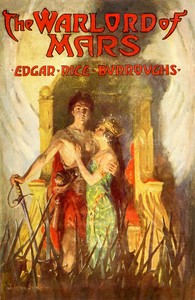
The warlord of Mars — Text and Context
(0 User reviews)
528
Project Gutenberg
1993
Not confirmed
Science fiction; Mars (Planet) -- Fiction; Carter, John (Fictitious character) -- Fiction; Dejah Thoris (Fictitious character) -- Fiction
Readers of public-domain and historical texts
Project Gutenberg digital edition
en
Edition facts
Words
61,001
Reading time
266 min
Text sections
17
This digital edition of The warlord of Mars — Text and Context is described by source-level measurements including 61,001 words, 4 hr 26 min estimated reading time, and 17 detected text sections.
The text analysis averages about 26.9 words per sentence, while the detected sections provide another way to judge how the source is divided.
Project Gutenberg metadata also associates the work with “Science fiction,” connecting these edition facts with the source record’s subject description.
Source:
Project Gutenberg record #68
This editorial note examines the structure, recurring imagery, and movement between scenes in Edgar Rice Burroughs' The Warlord of Mars, focusing on the protagonist's journey through the Carrion Caves and encounters with the yellow men.
Read the complete public-domain text at its original source.
Read on Project GutenbergThe Warlord of Mars opens with John Carter stalking a shadowy form through the Valley Dor, beneath the hurtling moons. The narrative immediately establishes a pattern of stealth and pursuit, a rhythm that persists across the book's seventeen sections. Burroughs builds tension through precise spatial details: the slow-revolving shaft of the Temple of the Sun, the six hundred and eighty-seven Martian days of Dejah Thoris's entombment. The prose moves between intimate, moment-by-moment observation and sweeping declarations of planetary scale, a structural oscillation that mirrors Carter's dual role as both lover and warlord.
The Rhythm of Pursuit and Observation
From the first paragraph, Carter is described as creeping stealthily along a trail, hugging darker places. This posture of concealed observation recurs throughout the excerpts. In the Carrion Caves, he and Thuvan Dihn move like snails, balancing on one foot over a sleeping apt, waiting breathlessly. The narrative slows to match the physical caution: each footstep, each breath is recorded. Later, behind a boulder, Carter watches the yellow men, peering round the granite mass. The pattern is consistent: Carter is often a watcher before he is a fighter. This structural choice emphasizes his role as an outsider navigating unknown territories, gathering intelligence before action.
Recurring Images of Confinement and Release
The image of the revolving temple shaft dominates the opening: a prison that rotates slowly, sealing Dejah Thoris from sight. This motif of confinement recurs in the Carrion Caves, described as a series of twenty-seven connecting chambers, eroded by water, now a labyrinth of sleeping beasts. The caves are a passage, but also a trap: the apts roam singly or in pairs except one day a month. The narrative dwells on the ooze of decaying flesh, the sucking noise of feet. Later, the yellow men's shields—small, concave—suggest a different kind of containment, deflecting blows rather than absorbing them. Each setting traps or channels movement, creating a geography of constraint.
Movement Between Scenes: From Underground to Polar Ice
The book's structure is defined by abrupt shifts in setting. The opening is claustrophobic: forest shadows, the temple shaft, the Lost Sea of Korus. Then the narrative moves to the Carrion Caves, a subterranean passage, and finally to a desolate country of snow and ice beyond the last cave. The transition is marked by a steep declivity leading into a valley, where the yellow men appear. Burroughs uses boulders as visual obstructions: the way is boulder-strewn, so that we could see but a short distance ahead. Each new scene is revealed gradually, as if the reader is also peering round a corner. This technique sustains uncertainty and emphasizes the vast, unknown geography of Barsoom.
The Yellow Men: A Study in Detail
The description of the yellow men is precise and functional. Their skin is the color of a ripe lemon; they wear furs—black and yellow striped orluk, or pure white apt. Their weapons are distinctive: a hooked sword, a straight two-edged sword, a short javelin, and a cup-like shield no larger than a dinner plate. Burroughs notes that the shields seem puny, but hints at their dexterous use. The narrative withholds full explanation, stating only that Carter was later to see the purpose of them. This restraint builds anticipation. The yellow men are introduced as a collective, huddled, watching someone approach. They are observed before they act, maintaining the pattern of Carter as spectator. The detail of the hooked sword suggests a different fighting style, preparing the reader for unfamiliar combat.
Readers attentive to Burroughs's structural choices will notice how each new environment—temple, cave, ice field—imposes its own rules of movement and perception. The narrative rewards patience: details introduced in one scene often gain significance later. The hooked sword, the apt's sleeping cycle, the boulder-strewn trail—these are not mere decoration but functional elements that shape the plot's progression. Approach the text as a series of carefully staged reveals, and the logic of Carter's journey becomes clearer.
Reading about the Carrion Caves, I remembered crouching in my childhood closet with a flashlight, the same held breath between worlds. It wasn’t just adventure—it was the weight of being utterly alone inside someone else’s imagination. Murray Leinster’s This World Is Taboo — Text and Context gave me that same quiet trespass, that feeling of walking somewhere no map ever accounted for.
There are no reviews for this eBook.
There are no comments for this eBook.
Reader reflection
What was your reading experience?
Capture what you thought, learned, and would like to remember.
Your progress
0
/
10
2
How much did you enjoy the reading experience?
3
Would you pass this book on to a friend?
4
How easy was the book to follow?
5
Would you start a conversation about this book?
6
How clear did the writing feel?
7
Did any part of the book stay with you emotionally?
8
How well did it match your expectations?
9
What is the main idea you are taking away?
10