1

Voodoo Planet — Reading Notes
(0 User reviews)
322
Project Gutenberg
2006
Not confirmed
Science fiction; Space ships -- Fiction; Life on other planets -- Fiction; Solar Queen (Imaginary space vehicle) -- Fiction
Readers of public-domain and historical texts
Project Gutenberg digital edition
en
Edition facts
Words
27,083
Reading time
118 min
Text sections
3
The catalog record for Voodoo Planet — Reading Notes provides practical reading context through 27,083 words, 1 hr 58 min estimated reading time, and 3 detected text sections.
The text analysis averages about 15.5 words per sentence, while the detected sections provide another way to judge how the source is divided.
Project Gutenberg metadata also associates the work with “Science fiction,” connecting these edition facts with the source record’s subject description.
Source:
Project Gutenberg record #18846
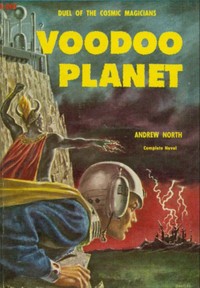
Andre Norton's 1959 novella follows Dane Thorson and Medic Tau as they confront Lumbrilo, a witch doctor whose hypnotic attacks blur reality on the planet Khatka. The narrative shifts from mundane spaceport labor to psychological warfare, emphasizing sensory detail and the fragility of perception.
Read the complete public-domain text at its original source.
Read on Project GutenbergAndre Norton opens Voodoo Planet with Dane Thorson sweating on Xecho, a water-world of “steam bath” heat and stinging sea organisms. The prose is tactile and immediate: Dane wipes his chest, tastes salt, and plods through sand. This physical grounding contrasts sharply with the later scenes on Khatka, where the enemy is not a creature but a hallucination. The early chapters establish a routine of cargo-master frustrations and shipboard banter, but the pace accelerates once Lumbrilo’s mental attacks begin. Norton uses short, punchy sentences during action sequences and longer, descriptive passages for setting, creating a rhythm that mirrors the shift from mundane to uncanny.
From Steam Bath to Psychic Siege
The novella’s opening on Xecho is deliberately oppressive: “Talk of heat—or better not—on Xecho.” Norton dwells on discomfort—sweat, salt, sun goggles—to establish a baseline of physical reality. Dane’s duties as acting cargo-master are described with concrete irritations: “snarl-ups,” slow riggers, a captain hiding in his cabin. This prosaic start makes the later transition to psychic combat more jarring. When the action moves to Khatka, the language shifts. Sentences grow shorter; the focus narrows to sensory fragments: “the crash of the waves,” “the treacherous promise of the bright sea.” The reader is primed to trust what Dane sees, which makes Lumbrilo’s illusions all the more disorienting. Norton never fully explains the mechanism of the hallucinations, leaving the reader as uncertain as the crew.
The Unreliable Senses of Dane Thorson
Dane serves as the point-of-view character, and Norton limits the narrative to his perceptions. When the hallucinatory leopard appears, Dane’s reaction is physical: he “slid his blade out surreptitiously, setting its point against the palm of his hand and jabbing painfully.” The pain is real, yet the creature persists. Later, Medic Tau diagnoses the attack as “mass hallucination,” but the text never confirms whether Lumbrilo uses drugs, hypnosis, or something else. Dane’s confusion is the reader’s. Norton reinforces this by having the characters debate the nature of the threat. Asaki’s outburst—“How was it done?”—echoes the reader’s own question. The narrative refuses to settle on a single explanation, keeping the focus on the characters’ struggle to distinguish real from unreal.
Pace and the Rhythm of Dread
Norton controls pace through sentence length and paragraph breaks. During the hallucination attack, sentences are clipped: “Words issued from between those curved fangs.” “Dane could hardly believe it yet.” The action is fragmented, mirroring the characters’ fractured perceptions. In contrast, the investigative scenes after the attack slow down. Tau methodically examines his medical supplies, and the dialogue becomes measured: “If these have been in any way meddled with, I would need laboratory analysis.” This alternation between frantic action and deliberate deduction creates a rhythm of tension and release. The final excerpt, where Tau collapses from exhaustion, suggests that the battle is ongoing. The novella ends not with a resolution but with a question: “How does he make us see what is not?” The pace leaves the reader unsettled, matching the characters’ uncertainty.
Readers should pay close attention to Norton’s use of sensory details—heat, pain, taste—as anchors in a world where perception is weaponized. The novella rewards those who track the shifts between concrete description and hallucinatory imagery. Note also how the characters’ professional roles (cargo-master, medic, ranger) shape their responses to the crisis. The story’s power lies not in its plot mechanics but in its sustained ambiguity about what is real.
I keep returning to that moment on Khatka, where the line between waking and trance dissolves. There's an old companion piece, Happy Rain Night — Inside the Classic, that lingers on similar quiet slippage. Norton knew how easily we lose our footing. I think about that whenever rain hits the window at odd hours, and the room feels suddenly less solid than I'd assumed.
There are no reviews for this eBook.
There are no comments for this eBook.
Reader reflection
Take a moment to reflect on this book
Create a short personal record of your experience with this book.
Your progress
0
/
10
2
How much did you enjoy the reading experience?
3
Would you encourage someone else to read it?
4
How much effort did this book require?
5
Did it raise ideas you would like to talk about?
6
Could you follow the author’s main argument?
7
Did this book create an emotional response?
8
Did anything about the book feel genuinely new?
9
Which lesson or insight stayed with you?
10