1

Passage to Planet X — Background and Themes
(0 User reviews)
36
Project Gutenberg
2020
Not confirmed
Science fiction; Adventure stories; Space ships -- Fiction; Life on other planets -- Fiction; Stowaways -- Fiction
Readers of public-domain and historical texts
Project Gutenberg digital edition
en
Edition facts
Words
15,669
Reading time
69 min
Text sections
2
For Passage to Planet X — Background and Themes, the stored edition analysis reports 15,669 words, 1 hr 9 min estimated reading time, and 2 detected text sections.
The text analysis averages about 11.2 words per sentence, while the detected sections provide another way to judge how the source is divided.
Project Gutenberg metadata also associates the work with “Science fiction,” connecting these edition facts with the source record’s subject description.
Source:
Project Gutenberg record #63694
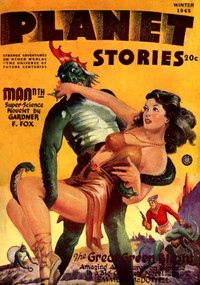
Henry Hasse's 1945 space adventure follows stowaway Mark Travers aboard a secret ship bound for a legendary planet beyond the solar system. The narrative moves between cramped ship corridors and an alien world where a mysterious Stone provides light and gravity, while colonists face the primitive Perlacs and reactivated robots.
Read the complete public-domain text at its original source.
Read on Project GutenbergThe story opens with a stowaway discovered: Mark Travers, caught aboard a ship that carries no insignia and filed no destination. The confrontation in the supply locker establishes a pattern of tense, physical negotiation—fists, a neutro-gun, and a hidden device that hums to inaudible frequencies. The ship itself feels improvised, its crew operating outside Interplanetary Code. This opening scene, with its quick shifts from violence to wary cooperation, sets a rhythm of suspicion and alliance that continues as the ship pushes toward a planet beyond all known charts.
Movement Between Confined and Open Spaces
The narrative alternates between tight interiors—ship corridors, cabins, laboratories—and the open, strange landscape of Planet X. Early scenes are dominated by the ship's forward thrust, the crew bracing against acceleration, and the claustrophobic search of a stowaway. Once on the planet, the setting opens into a hemisphere of light and shadow, with a hilltop Stone at its center. The colonists' settlement is described through workshops and a glass-topped chart table, but the threat of the Perlacs lurks in the twilight zone. This spatial contrast reinforces the journey from secrecy to exposure, from human-made rules to alien physics.
Recurring Images of Hidden Devices and Ancient Science
Mark's camera-like box, which hums with inaudible coils, is the first of several objects that blur the line between tool and weapon. Later, the colonists reveal they are trying to reinvent the neutro gun from an ancient book, Evolution and Control of the Free Electron. The Stone itself is described as a shiny chunk that defies physical laws, feeding on gravity. These recurring images—hidden mechanisms, rediscovered science, and a central artifact that alters the planet's fundamental forces—create a texture of mystery. The narrative does not explain the Stone's origin, only that it was buried and dug out by ancestors.
Voice and Dialogue as Character Markers
Dialogue carries much of the exposition and character definition. Mal Driscoll's clipped, practical speech contrasts with Mark's sardonic calm: “Careful, there, I'm ticklish!” The colonists speak in longer, explanatory sentences, especially Brownell, who delivers key information about the Stone and the Perlacs. Janus, the commander, is terse and decisive. The girl Mari shifts between excitement and warning. These vocal differences map the social structure: the ship's crew operates on direct action, while the colonists are scholars and engineers. The Perlacs are never heard directly, only described as savages using explosives and ancient science.
Structure of Revelation and Escalation
The plot unfolds through a series of revelations, each building on the last. First, the ship's secret mission; then, the planet's strange properties; then, the Stone's gravity-defying nature; finally, the threat of the Perlacs and the robots. Each section introduces a new layer of danger or wonder. The demonstration of the atomic rifle and neutro-pistol serves as a turning point, showing the colonists that Earth technology can counter the Perlacs. The narrative structure mirrors the journey: from concealment (the stowaway, the unregistered ship) to open conflict (the Perlacs' attacks, the robots' activity). The excerpts end before the climax, leaving the resolution unknown.
Readers should pay attention to how objects—the camera, the Stone, the weapons—function as both plot devices and symbols of knowledge. The story's movement between ship and planet, between human law and alien physics, rewards attention to small details of setting and dialogue. The incomplete excerpts leave the fate of the colonists and the nature of the Perlacs unresolved, making the text a fragment of a larger imagined world.
Mark Travers’s huddled hours in those secret corridors always remind me of another young soul aboard another rocket, both echoing the same lonesome hum. There is a fond, patient kinship between stranded folk navigating strange skies. I often find myself pulling Hasse’s worn pages next to Rhythm rides the rocket — Story, Setting & Ideas, and the two share a quiet, clockwork pulse—one of solitude, survival, and the odd comfort of machinery humming along with us.
There are no reviews for this eBook.
There are no comments for this eBook.
Reader reflection
Before you leave, reflect on the book
Use these questions to collect your thoughts before moving on.
Your progress
0
/
10
2
How much did you enjoy the reading experience?
3
How likely are you to recommend this book?
4
How much effort did this book require?
5
How useful were the ideas in this book?
6
How did the reading compare with what you expected?
7
How strong was your personal connection to the text?
8
How would you describe its reading pace?
9
What did this book teach you most?
10