1

Hellflower — Text and Context
(0 User reviews)
478
Project Gutenberg
2023
Not confirmed
Science fiction; Man-woman relationships -- Fiction; Drug traffic -- Fiction; Space ships -- Fiction; Human-alien encounters -- Fiction; Drug addicts -- Fiction
Readers of public-domain and historical texts
Project Gutenberg digital edition
en
Edition facts
Words
69,492
Reading time
303 min
Text sections
6
Before opening Hellflower — Text and Context, the edition data offers a quick orientation: 69,492 words, 5 hr 3 min estimated reading time, and 6 detected text sections.
The text analysis averages about 14.3 words per sentence, while the detected sections provide another way to judge how the source is divided.
Project Gutenberg metadata also associates the work with “Science fiction,” connecting these edition facts with the source record’s subject description.
Source:
Project Gutenberg record #69762
A space trader's cynical return to action after a ruined career, entangled with a drug-like flower that targets women and a woman who may be immune. The narrative moves between Venusian fungus fields, shipboard negotiations, and tense romantic games, with recurring motifs of burned-out men and dangerous allure.
Read the complete public-domain text at its original source.
Read on Project GutenbergThe novel opens with Charles Farradyne, a man who has been metaphorically and literally burned out, working in the fungus fields of Venus. The first sentence—"The book had been thrown at Charles Farradyne"—establishes a tone of bitter defeat, reinforced by the image of printer's ink as a final smear. Howard Clevis's arrival, offering a job, immediately sets up a tension between Farradyne's self-described status as a "bum" and the possibility of redemption. The dialogue is sharp and cynical, with Farradyne's laugh described as "all scorn and no humor."
Movement Between Worlds
The story shifts rapidly from the squalid rooming house on Venus to the interior of a spaceship, and later to Mercury. These transitions are not merely scenic; they mirror Farradyne's psychological state. On Venus, he is a beaten man, surrounded by fungus fields and cheap lodgings. The ship, by contrast, becomes a stage for verbal sparring and strategic maneuvering. The movement is often abrupt, with little description of the journey itself, focusing instead on the change in social dynamics. The setting of Mercury, where "we see no stars," further emphasizes a claustrophobic, artificial environment that heightens the tension between Farradyne and Carolyn.
The Hellflower as a Recurring Image
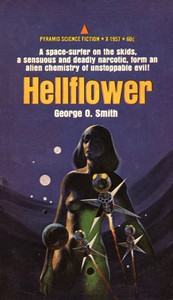
The hellflower appears first in the book's tagline—"It looked as innocent as a gardenia"—and then as a physical object that Farradyne places in Carolyn's hair. The flower is a device that tests loyalty and desire: it is said to turn any woman into "any man's woman," yet Carolyn seems immune. Farradyne's act of throwing the flower into the ship's reaction blast is a deliberate destruction of a symbol, but the flower's presence lingers in the dialogue. The recurring image of the flower—its perfume, its deceptive appearance—ties together the themes of addiction, control, and the risk of emotional exposure.
Structure of Verbal Duels
The narrative is built around extended conversations that function as psychological contests. Farradyne and Carolyn engage in a game of mutual testing, where each line of dialogue carries subtext about power and attraction. For instance, Farradyne's speech about noblesse oblige and his refusal to "make with happy-talk" reveals a character who is constantly calculating. The structure of these scenes—often in confined spaces like a control room—creates a sense of intimacy and threat. The dialogue is laced with irony and double meanings, as when Farradyne admits he lied about the flower's origin, turning the exchange into a confession of strategy.
Burned-Out Men and Second Chances
Farradyne is introduced as "a beaten man who no longer burned with resentment because he was all burned out." This image of burnout recurs throughout the excerpts, from his work in the fungus fields to his cynical refusal of Clevis's offer. The novel's structure hinges on whether a man who has been "burned out" can re-engage with risk and desire. Carolyn, too, is described in terms of fire—she "liked to play with fire"—and the stakes are framed as a game where "the loser never came to bat again." The language of combustion and exhaustion gives the story a consistent metaphorical weight.
The Role of the Observer
Several scenes are filtered through Farradyne's internal calculations, as when he mentally notes that Carolyn "could hardly have known about the visit of Norma Hannon" and that he has "put the woman on her guard." This narrative strategy keeps the reader aware of the gap between what is said and what is known. The structure of revelation—where information about the hellflower and Carolyn's immunity is disclosed piecemeal—creates a puzzle for the reader. The excerpts show that the story is as much about the process of discovery as it is about the romance or the drug trade.
Readers should pay attention to the way the novel uses physical objects—the flower, the ship, the fungus fields—as anchors for emotional states. The dialogue is dense with subtext, and the movement between settings often signals a shift in power. The incomplete excerpts leave open questions about Carolyn's true nature and the ultimate fate of the hellflower, but the patterns of verbal sparring and burned-out resilience are established early and consistently.
I keep thinking about how burned-out men and dangerous flowers keep showing up in my reading, and then I remember the quieter ache in Hellflower — Text and Context. It reminds me, in a roundabout way, of the patient notes in The prince of space — Reading Notes, where the longing is worn soft, like an old jacket. Some obsessions just settle in gently.
There are no reviews for this eBook.
There are no comments for this eBook.
Reader reflection
Your personal reading reflection
Build a private reading journal entry for this title.
Your progress
0
/
10
2
How much did you enjoy the reading experience?
3
Would you pass this book on to a friend?
4
Did the language feel accessible?
5
Could you see yourself revisiting this book?
6
What did you appreciate most?
7
How useful did the reading feel?
8
Was the book easy to understand?
9
Which lesson or insight stayed with you?
10