1

Blind Man's Lantern — Context and Discussion
(0 User reviews)
219
Project Gutenberg
2008
Not confirmed
Science fiction; Short stories; Amish -- Fiction; Space colonies -- Fiction
Readers of public-domain and historical texts
Project Gutenberg digital edition
en
Edition facts
Words
15,571
Reading time
68 min
Text sections
2
This digital edition of Blind Man's Lantern — Context and Discussion is described by source-level measurements including 15,571 words, 1 hr 8 min estimated reading time, and 2 detected text sections.
The text analysis averages about 16.6 words per sentence, while the detected sections provide another way to judge how the source is divided.
Project Gutenberg metadata also associates the work with “Science fiction,” connecting these edition facts with the source record’s subject description.
Source:
Project Gutenberg record #24567
Allen Kim Lang's 1962 novella follows Amish colonists Aaron and Martha Stoltzfoos as they settle the planet Murna, blending Old Order traditions with space-age agriculture. The story's structure alternates between shipboard departure and planetary adaptation, using recurring images of lanterns, microscopes, and soil to explore cross-cultural exchange between Amish and Nigerian-descended Murnans.
Read the complete public-domain text at its original source.
Read on Project GutenbergThe story opens not with a starship but with a Hausa proverb: a blind man carrying a lantern to warn sighted fools. This fable sets the tone for a narrative that repeatedly pairs apparent contradictions—Amish farmers in space, a bacteriologist in a prayer-covering, a game of Mosch Balle played on an alien world. Allen Kim Lang's 1962 novella moves from the enclosed metal of a colony ship to the open fields of Murna, tracking Aaron and Martha Stoltzfoos as they unload a plow, seed, chickens, and a microscope designed to work by lamplight. The structure is episodic, alternating between the couple's departure and their gradual integration into a community of Nigerian-descended Murnans. Recurring images—lanterns, soil, livestock, and the Stoltzfoos's black clothing—anchor the speculative premise in tangible, earthy detail.
From Ship to Soil: The Opening Transition
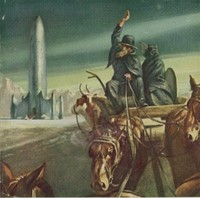
The first excerpt establishes a stark contrast between the sterile ship and the cold Murnan air. Captain and Amishman shake hands; Martha Stoltzfoos sits aside, blushing at an accidental inch of stocking. The cargo list is precise: plow, seed, chickens, a round tabletop, an alcohol-burning incubator, agar-powder, a pressure cooker, a lamplight microscope. And a pig named Wutzchen, snuffling with impatience. The scene is framed by the captain's offer of ship's stores and Aaron's refusal—they have all that's needful. The landing ramp tongues out, horses stomp, and the world outside is cold. Lang uses concrete nouns to ground the transition: the wagon holds not just goods but a whole way of life, packed tight enough to wall in the pig. The structure here is a departure scene that doubles as an arrival, the ship's metal giving way to Murnan earth.
Teaching and Learning: The Exchange of Knowledge
The second excerpt shifts to a series of questions from Murnan farmers, each answered by Aaron with help from Waziri, who supplies—and often invents—Hausa words for concepts like phosphorus and litmus. The structure is a catalogue of queries: What is the powder for bean-seeds? Why burn tobacco beds? What devils do the needles exorcise? What are the blue and pink papers pressed into mudballs? Aaron's answers are practical—nitrogen-fixing symbiotes, steaming soil, disease-process, litmus tests. But the exchange is reciprocal: Aaron learns to plant seed-yams, peanuts, fonio, and refuses to grow henna for vanity. The recurring image of the microscope ties back to Martha's lamplight instrument, a tool that introduces bacteria to the Murnans. Lang presents knowledge as a two-way street, with Aaron translating his Amish science into Hausa and adopting Murnan crops. The paragraph structure piles detail on detail, mirroring the accumulation of agricultural wisdom.
Sunday Play: A Game of Mosch Balle
On a Sunday, after singing from the Ausbund and reading from the Schrift and Martyr's Mirror, Aaron proposes a game. The Murnan guests include Sarki Kazunzumi (the local chief) and Musa the carpenter, along with farmers and craftsmen. Aaron observes that the two classes maintain a polite fiction of each other's absence. His solution: a game of ball. Not baseball, an English sport foreign to Amishmen, but Mosch Balle, a barnyard game. The scene echoes the earlier proverb—the blind man's lantern as a social tool—as Aaron uses play to bridge status divisions. The structure here is a pause in the agricultural narrative, a moment of recreation that reveals character and community. Lang's choice of game is specific: a softball substitute that fits a barnyard, not a stadium. The episode underscores how the Amishman's traditions, from worship to sport, become points of connection on Murna.
Recurring Images: Lanterns, Soil, and Livestock
Throughout the excerpts, certain images recur with the insistence of a motif. The lantern from the Hausa proverb appears implicitly in the lamplight microscope and the candle-snuffer Kapp Martha adjusts. Soil is a constant: bean-seeds dusted with powder, tobacco beds burned, mudballs with litmus slips, sacks of fertilizer. Livestock—horses, chickens, pigs, cattle—anchor the story in barnyard reality. The pig Wutzchen, named with a diminutive, is both a character and a promise of future pork. Lang's prose lingers on these objects, giving them weight beyond metaphor. The structure of the narrative itself mirrors the cycle of planting and harvest: departure, adaptation, exchange, and growth. The blind man's lantern, carried not for himself but to warn others, becomes a figure for the Amish presence on Murna—a light that illuminates not the bearer but the path for those with eyes to see.
Readers will find that Blind Man's Lantern rewards attention to its small details: the inch of black stocking, the snuffling pig, the blue-and-pink litmus slips. Lang builds a world not through grand gestures but through the accumulation of specific, tactile objects. The story's structure—episodic, grounded in work and play—invites a slow reading that savors each exchange. Approach it as you might a barn raising: piece by piece, with an eye for the craft.
There’s something about the Stoltzfooses’ lanterns and soil that stays with you, a quiet ache for roots in strange ground. It reminded me of another gentle oddity, Lancelot Biggs cooks a pirate — Edition Insights, where the absurd and the tender keep overlapping in that same unhurried way. I kept thinking of both long after closing them.
There are no reviews for this eBook.
There are no comments for this eBook.
Reader reflection
How will you remember this book?
Save your reaction, strongest insight, and memorable passage.
Your progress
0
/
10
2
How much did you enjoy the reading experience?
3
Is this a title you would suggest to others?
4
How much effort did this book require?
5
Was the book what you thought it would be?
6
Would you read this book again?
7
Did any part of the book feel personally relevant?
8
What was its emotional impact?
9
In one sentence, what did you learn?
10