1

Barnstormer — Context and Discussion
(0 User reviews)
453
Project Gutenberg
2021
Not confirmed
Science fiction; Short stories; Boys -- Fiction; Space ships -- Fiction; Families -- Fiction
Readers of public-domain and historical texts
Project Gutenberg digital edition
en
Edition facts
Words
5,805
Reading time
26 min
Text sections
1
Barnstormer — Context and Discussion can be approached with a clearer sense of reading commitment from its source measurements: 5,805 words, 26 min estimated reading time, and 1 detected text section.
The text analysis averages about 15.5 words per sentence, while the detected sections provide another way to judge how the source is divided.
Project Gutenberg metadata also associates the work with “Science fiction,” connecting these edition facts with the source record’s subject description.
Source:
Project Gutenberg record #65348
In this 1957 science fiction short story, a boy named Pete is drawn to a rocketman named Murph and his silver ship, while his grandmother and mother, both widowed by space disasters, view the rocket with fear and resentment. The story contrasts Pete's yearning for space with his family's grief.
Read the complete public-domain text at its original source.
Read on Project GutenbergTom W. Harris's 1957 short story 'Barnstormer' opens with a boy named Pete sneaking across fields toward a 'glass rocket' that he sees as 'all the promise in the world distilled into a pointed black glass bottle.' The story quickly establishes a generational conflict: Pete's grandmother and mother view the rocket as 'a monstrous and terrible symbol,' a reminder of husbands lost to space. The grandmother's complaint—'No reason for men to want to go way off hundreds of miles from earth'—sets up a tension between youthful aspiration and adult grief that drives the narrative.
Generational Conflict and Gendered Perspectives
The excerpts reveal a sharp divide between Pete's excitement and the women's sorrow. The grandmother and mother are both widowed by spaceflight: the grandmother's husband died when 'the early test ship burst on the moon-run,' and Pete's father perished when his ship's coating peeled and it 'took the full, brutal hammer of the sun.' Their grief is palpable, and they express it through hostility toward the rocket. The grandmother calls the pilot a 'barnstormer,' a term that links space travel to the risky, itinerant aviators of an earlier era. Pete, in contrast, sees the rocketman as a 'slash-grinned young god.' The story uses these opposing viewpoints to frame space exploration not as pure adventure but as a source of both wonder and loss.
Language and Voice: Slang and Sentiment
Harris gives Pete a distinctive slang: 'Aw—fooher! Fooner!' and later 'Aw fooner.' The grandmother's reaction—'Where do they pick up that awful slang?'—highlights the generational gap. This invented exclamation is one of the few direct markers of Pete's youth, alongside his mother's gesture of running fingers through his 'spiky hair.' The narrative voice shifts between Pete's perspective and the women's interior thoughts, as when 'their thoughts ran to space and rockets and their men, who had been rocketmen and who would never come back.' The prose is economical, using concrete details—'the black glass rocket lift high on its fine blue skirt'—to evoke wonder without sentimentality.
Structure and the Unseen Ending
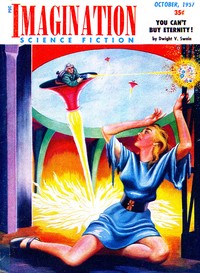
The excerpts cover only the story's opening and a later scene where Pete watches the rocket's flights from a pine tree. The narrative arc is incomplete: we see Pete's determination ('I'll be a spaceman') and his observation of the rocket's final ascent, but we do not learn whether he ever gets his promised ride. The story's title, 'Barnstormer,' and the catalog subject 'Boys -- Fiction' suggest a coming-of-age trajectory, but the excerpts leave Pete's fate ambiguous. The text's brevity (5,805 words) and its origin in a 1957 pulp magazine (Imagination Stories of Science and Fantasy) indicate a tight, focused narrative that prioritizes a single emotional arc over world-building.
Readers should note that the excerpts do not reveal the story's resolution. The tension between Pete's longing and his family's grief is established but unresolved in the available text. The story's brevity and pulp origin suggest a swift conclusion, but the outcome of Pete's quest—whether he rides the rocket or is held back—remains unknown. The catalog subject 'Families -- Fiction' hints that the resolution may involve reconciliation or further conflict, but the excerpts alone do not confirm this.
I keep thinking about Pete in that story, how he sees the silver ship while his mother and grandmother only see the hole it might leave. That ache between wanting and remembering—it stayed with me. When the atoms failed — Background and Themes carries a similar quiet weight, though in a different shade. I found myself pausing over the pages, the way you do when something feels true without needing to say so out loud.
There are no reviews for this eBook.
There are no comments for this eBook.
Reader reflection
Your personal reading reflection
Build a private reading journal entry for this title.
Your progress
0
/
10
2
What was your overall reaction to the book?
3
Is this a title you would suggest to others?
4
How much effort did this book require?
5
Did any part of the book feel personally relevant?
6
How useful did the reading feel?
7
How original did the book feel?
8
Did this book create an emotional response?
9
Which lesson or insight stayed with you?
10