1

Formula for Conquest — Reading Companion
(0 User reviews)
2285
Project Gutenberg
2020
Not confirmed
Science fiction; Short stories; Scientists -- Fiction; Adventure stories; Mercenary troops -- Fiction
Readers of public-domain and historical texts
Project Gutenberg digital edition
en
Edition facts
Words
10,372
Reading time
46 min
Text sections
2
This digital edition of Formula for Conquest — Reading Companion is described by source-level measurements including 10,372 words, 46 min estimated reading time, and 2 detected text sections.
The text analysis averages about 16.0 words per sentence, while the detected sections provide another way to judge how the source is divided.
Project Gutenberg metadata also associates the work with “Science fiction,” connecting these edition facts with the source record’s subject description.
Source:
Project Gutenberg record #63632
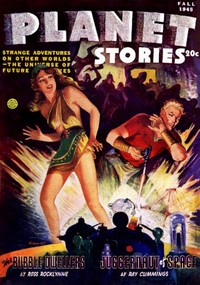
In this 1945 Planet Stories novella, mercenary Tod Mulhane teams with inventor August Q. Twilken to thwart an interplanetary conspiracy. The catalog subjects 'Scientists -- Fiction' and 'Mercenary troops -- Fiction' are accurate, but the story's focus on political maneuvering and alien biology (evolved Plutonians of calcium carbonate) goes beyond simple adventure.
Read the complete public-domain text at its original source.
Read on Project GutenbergThe story opens with a distinctive voice: Tod Mulhane, a soldier of fortune, narrates in a hard-boiled, slangy style that immediately establishes him as a cynical pragmatist. He describes a 'mangy crew whooping it up' in a 'Martian musk-parlor,' and his first action is to punch a stranger in the ribs to keep him quiet. This is not a scientist's story but a mercenary's, despite the catalog subject 'Scientists -- Fiction.' The scientist, Professor August Q. Twilken, is introduced as a 'mild-mannered, shrimp of a man' with 'milky-blue eyes' and a 'bedraggled gray mustache'—a figure of comic contrast to Mulhane's rough worldliness.
Voice and Setting: A Pulp Noir in Space
The narrative voice is central to the story's effect. Mulhane's first-person account is peppered with colloquialisms ('guy,' 'startin' someone's ears to burnin'') and a performative cheerfulness ('singing and laughing, as though I had an overload of Meez-musk'). The setting—a 'close confines of the ill-smelling Martian musk-parlor'—is a classic pulp backdrop, but the author uses it to ground the interstellar politics in a seedy, tangible environment. The dialogue is brisk and functional, with Mulhane's gruffness contrasting Twilken's earnestness. When Twilken declares, 'We're going to save them from the coming Interplanetary War!', Mulhane's internal reaction—'thinking maybe I had a nut on my hands'—keeps the tone skeptical and grounded.
The Conspiracy and Its Players
The plot revolves around a grand alliance of Jupiter, Saturn, and Uranus against the Allied Worlds (Mars, Earth, Neptune). The excerpts show a detailed political setup: delegates like 'Taj Morkus and Klex II of Saturn' and 'Wen Dorn and the intellectual, if perverted, scientist, Haljin from Uranus' are named, along with the villainous 'Mon Pordo' and the jewel-laden 'Xan VIII.' The catalog subject 'Adventure stories' fits, but the story also includes a council scene with 'exactly one hundred figures' and 'evolved Plutonians' whose biology is key. Twilken identifies them as 'composed almost entirely of an impure form of calcium carbonate,' a scientific detail that drives the plan. This blend of space opera and pseudo-science is more intricate than a simple mercenary tale.
Action and Its Consequences
The excerpts include a violent sequence where Mulhane uses an electric charge on Jovians, leaving 'a sickening mass of blackened, cooked flesh.' The description is stark and unglamorous: 'Augie poked his head through the door and gagged wretchedly at the charnel sight.' Mulhane's justification—'It was necessary'—reflects his pragmatic morality. Later, the infiltration of the palace involves climbing vines to a balcony overlooking the assembly. The action is efficient, but the story also pauses for observation, such as Mulhane noting the Plutonians' 'sick, yellowish-white' color and 'something about their flesh' that bothers him. These details suggest the author is interested in more than just fast-paced adventure; there is a layer of speculative biology and political intrigue.
Readers should note that the excerpts cover only the first half of the story, ending just as the plan against the Plutonians is set in motion. The catalog subjects accurately flag the mercenary and scientist leads, but the political machinations and alien biology are equally prominent. The story rewards attention to its world-building details, such as the specific planetary alignments and the physical description of the Plutonians, which may become crucial later. Approach it as a mid-century pulp that blends hard-boiled narration with speculative science.
Rereading the Formula for Conquest companion, I found myself lingering on Twilken’s patient, almost tender study of the Plutonians—their strange biology not as a threat, but a puzzle. It made me think of another quiet guide I once kept, one that treated a different story’s details with the same gentle care. There’s a softness in that approach, Birthday Present — A Reader’s Guide explores, that I find myself remembering warmly.
There are no reviews for this eBook.
There are no comments for this eBook.
Reader reflection
Record your reading impressions
A brief reflection can help important ideas stay with you longer.
Your progress
0
/
10
2
Was reading this book enjoyable?
3
Would you encourage someone else to read it?
4
What was the reading difficulty like?
5
How clear did the writing feel?
6
How would you describe its reading pace?
7
Which part made the strongest impression?
8
Did the book deliver what you hoped for?
9
What changed or sharpened your thinking?
10