1

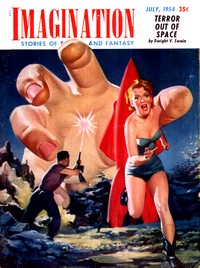
Birthday Present — A Reader’s Guide
(0 User reviews)
873
Project Gutenberg
2021
Not confirmed
Science fiction; Short stories; Noir fiction; Man-woman relationships -- Fiction; Murder -- Fiction
Readers of public-domain and historical texts
Project Gutenberg digital edition
en
Edition facts
Words
4,182
Reading time
19 min
Text sections
1
For Birthday Present — A Reader’s Guide, the stored edition analysis reports 4,182 words, 19 min estimated reading time, and 1 detected text section.
The text analysis averages about 14.9 words per sentence, while the detected sections provide another way to judge how the source is divided.
Project Gutenberg metadata also associates the work with “Science fiction,” connecting these edition facts with the source record’s subject description.
Source:
Project Gutenberg record #66379
In Arnold Marmor's noir science fiction short story, a man recounts his involvement in a murder plot orchestrated by his lover, Diane, whose husband works on Mars. The narrative moves between tense planning and the protagonist's internal conflict, using recurring images of physical intimacy and violence.
Read the complete public-domain text at its original source.
Read on Project GutenbergArnold Marmor's 'Birthday Present' opens with a confession of complicity: 'It's tonight or never,' Diane says, and the narrator, Paul, agrees. The story immediately establishes a claustrophobic intimacy—Diane paces across Paul's bedroom floor, her 'sheer plasto dress' described in precise, sensual detail. The setting is a near-future where space travel is routine, yet the emotional landscape is recognizably noir: a love triangle, a planned murder, and a protagonist who admits he is 'twenty-four and in love' with a woman six years his senior. The excerpt moves swiftly from whispered plans to the physical reality of a wrench gripped in a sweaty hand, grounding the speculative elements in a visceral, human drama.
A Tightly Wound Opening
The story's first scene is a masterclass in compression. Within a few paragraphs, Marmor establishes the relationship, the plan, and the moral stakes. Diane's dialogue is clipped and commanding—'Just crouch low. As soon as we're away from the spaceway you hit him with the wrench'—while Paul's responses are laced with hesitation and desire. The repeated phrase 'I love you' becomes a kind of incantation, a verbal anchor against the violence they are about to commit. The physical details—the 'light blue veins criss-crossing under the delicate skin' of Diane's wrist—create a stark contrast between tenderness and brutality. This opening sequence sets a breathless pace, with no wasted words, pulling the reader into the narrator's conflicted consciousness.
Recurring Images of Confinement and Exposure
Marmor uses spatial imagery to mirror the characters' psychological states. The planning takes place in a bedroom, a private space that becomes a trap. Paul crouches 'low in the back of the racer,' a position of physical submission that echoes his emotional subservience. The city sounds—'street noises, the gab of the night crowds, the not-so-mild cursings of the taxi-jet drivers'—intrude as a chaotic backdrop, emphasizing the isolation of the conspirators. Diane's body is described in fragments: 'round white breasts,' 'full milky thighs,' 'slim white column that was her throat.' These recurring images of whiteness and vulnerability contrast with the cold metal of the wrench, suggesting a collision of desire and destruction. The movement between enclosed spaces (bedroom, racer) and the open city creates a rhythm of tension and release.
The Narrator's Unreliable Self-Awareness
Paul's narration is marked by a peculiar detachment. He observes his own actions as if from a distance: 'I poured myself a drink. I needed it. I was going to need a lot more.' This self-consciousness does not lead to moral clarity; instead, it highlights his passivity. He thinks about 'telling Diane to go to hell and to get herself another stooge,' but the thought dissolves into the image of her face. The story's structure—a first-person account that begins in medias res—leaves the reader uncertain whether Paul is reflecting on past events or narrating in real time. His repeated use of 'I thought about' suggests a mind circling the same dilemma without resolution. This interior conflict, set against the concrete plan of murder, gives the story its psychological weight.
Speculative Elements as Atmospheric Detail
The science fiction setting is understated but integral. Diane's husband 'spent most of his time on Mars,' and the spaceway is a routine travel hub. These details are not explained or dwelt upon; they function as background texture, normalizing a world where interplanetary commuting coexists with domestic noir. The 'plasto dress' and 'racer' vehicle are mentioned without fanfare, grounding the story in a specific technological moment. This restraint keeps the focus on the human drama. The murder plan—to make the death look like a suicide, with a doctor ready to testify—echoes classic noir plots but gains a slight estrangement from the futuristic context. Marmor uses the speculative elements sparingly, as a lens to sharpen the timeless themes of jealousy, obsession, and betrayal.
Readers should pay close attention to the story's use of repetition and variation. Phrases like 'I love you' and 'It's all clear' recur, shifting in meaning as the plan progresses. The narrative's brevity—under 4,200 words—means every detail carries weight. Notice how Marmor balances the external action (the drive to the spaceway) with internal monologue, creating a layered portrait of a man on the verge of a violent act. The ending, though not included in the excerpt, is likely to hinge on the tension between the planned murder and the narrator's wavering resolve.
I keep thinking about how that birthday gift in Marmor's story stays with you, that ache between tenderness and betrayal. It’s the same uneasy quiet that lingers in Heist Job on Thizar — A Reader’s Guide, where loyalty frayes under pressure, and every plan feels like a confession waiting to happen. Some stories just leave that weight in your chest, don’t they?
There are no reviews for this eBook.
There are no comments for this eBook.
Reader reflection
What did you think of this book?
Answer a few questions and save a private reflection on this device.
Your progress
0
/
10
2
Was reading this book enjoyable?
3
Is this a title you would suggest to others?
4
How much effort did this book require?
5
Which part made the strongest impression?
6
Would this book work well in a reading group?
7
Could you follow the author’s main argument?
8
Did this book create an emotional response?
9
What changed or sharpened your thinking?
10