
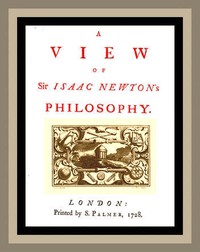
A View of Sir Isaac Newton's Philosophy by Henry Pemberton
The Story
So here’s the deal: Henry Pemberton was a doctor and mathematician who actually hung out with Sir Isaac Newton later in life. After Newton passed away in 1727, Pemberton wanted to share the genius’s ideas with the everyday reader. Published in 1728, *A View of Sir Isaac Newton’s Philosophy* isn’t trying to teach you advanced calculus. Instead, Pemberton walks you through Newton’s greatest hits: the laws of motion (F=ma, but in plain English), the nature of light (prisms are heroes), and how gravity keeps everything from flying off into space. The book keeps it simple on purpose—think of it as a smart friend summarizing a 500-page textbook into a fun lecture at 18th-century coffee shop.
Why You Should Read It
Honestly, this book is a goldmine for anyone who’s ever said, 'I wish I could talk to Newton without going back to school.' Pemberton has this easy voice that mixes humility ('I tried my best to explain what Sir Isaac told me') with wonder. The coolest part? You get a front-row seat to how people in the 1700s wrestled with radical ideas like black holes (yes, Newton knew about those) and the ocean’s tides. Plus, the historical side—like angry letters from Newton’s rivals—makes the science feel alive. It’s perfect if you’ve snored through a modern physics textbook and want to refresh the why-back-then magic.
Final Verdict
This is NOT the book for someone who just wants cold equations or battle stats. It’s for history nerds, science fans who love backstage stories, and anyone who cheers when an old idea suddenly makes sense. If you’re cool with a gentle learning curve and want to feel like you’re sharing tea with a genius, grab it. Skip it if you want pure modern theory or heavy math—Pemberton keeps math to a whisper. Perfect for curious minds ready to time-travel through ideas.
No rights are reserved for this publication. You can copy, modify, and distribute it freely.
David Taylor
11 months agoAfter spending a few days with this digital edition, the data points used to support the main thesis are quite robust. Definitely a five-star contribution to the field.
Patricia Thomas
11 months agoUnlike many other resources I've purchased before, the logic behind each conclusion is easy to follow and verify. It cleared up a lot of the confusion I had previously.







Margaret Garcia
1 year agoThis was exactly the kind of deep dive I was searching for, the transition between theoretical knowledge and practical application is seamless. Simple, effective, and authoritative – what else could you ask for?